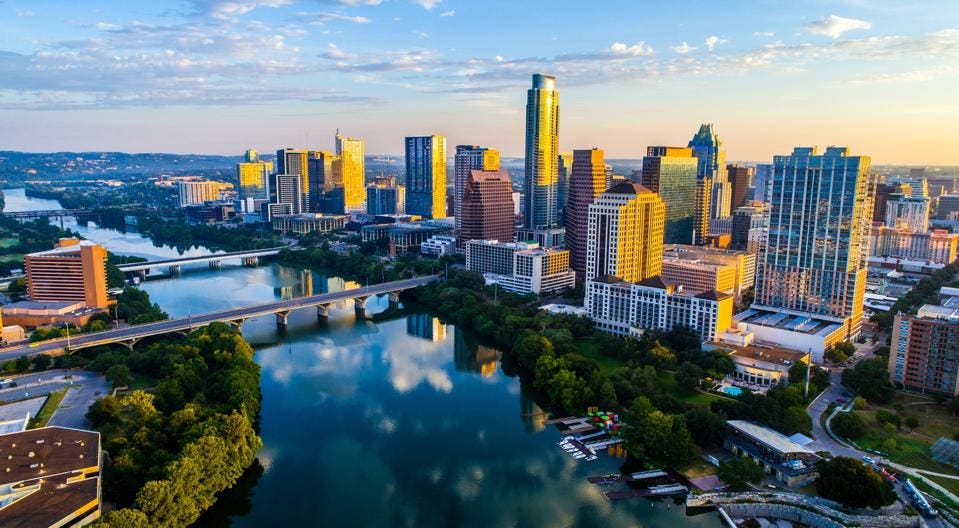
If you ran the Butler Trail's east end on a Saturday morning in early February, you would have found actual crowds gathered at a bridge. Ribbon cutting, live music, food trucks, a small crowd of downtown residents standing on brand new concrete watching city officials cut a ribbon over water that had, for more than fifty years, forced trail users onto the shoulder of Pleasant Valley Road. That was the Wishbone Bridge, and for the first time since the trail existed, you could complete the full ten-mile circuit around Lady Bird Lake without stepping onto pavement shared with cars.
By late summer, if you tried the same loop on the north shore near the Austin Rowing Club, you'd hit a detour sign instead.
That is the real story for anyone living downtown right now. Not that the loop got fixed. That trail work continues on a different stretch.
The stretch near Longhorn Dam was the trail's oldest problem. Since Longhorn Shores was developed in the mid-1970s, anyone trying to connect the eastern and southeastern segments of the Ann and Roy Butler Hike and Bike Trail had to leave the path entirely and walk the narrow sidewalk on Pleasant Valley Road, next to fast-moving traffic, right where the road crosses the dam. City planners started studying a fix back in 2018. Construction on the answer, a three-legged pedestrian and cycling bridge shaped like a wishbone, began in July 2024.
The bridge that opened on February 7, 2026 cost roughly $25 million, funded mostly through the city's 2020 mobility bond with more than $4 million in federal funding secured by Congressman Greg Casar. Its two curved legs run about 230 feet each and meet at a 76-foot-wide central plaza built for people to actually stop and look at the water, not just pass through. A 130-foot mural-lined tunnel carries trail traffic under South Pleasant Valley Road so pedestrians and cyclists never have to touch the road surface at all. According to the city, more than 2.6 million people use the Butler Trail every year, and this was the last place on the entire ten-mile loop where any of them had to step off it.
For anyone who lives downtown and treats this trail as a daily fixture, that's not a minor infrastructure update. It's the first time in the trail's history that the full loop has been genuinely continuous.
Here's the part that doesn't make it into the celebratory coverage. Starting July 27, 2026, the city began staging construction near the Austin Rowing Club boathouse at 74 Trinity Street for the Waller Beach Duct Bank Upgrade, an Austin Energy project laying new underground electrical infrastructure between Brazos Street and Trinity Street. Trail users are now detoured toward Cesar Chavez Street around the boathouse. A separate but concurrent Austin Water emergency repair in the same stretch has closed the Confluence's lattice bridge, the crossing that normally connects the east bank of Waterloo Greenway to the Waller Creek Boat House, rerouting anyone coming from that direction south to the Hartman Bridge crossing instead.
This isn't a weekend closure. According to the city, the detour is expected to remain in place through summer 2027.
The reason behind it is worth sitting with for a second, because it says something about where downtown is headed rather than just what's inconvenient right now. The project is routing more power from the Rainey Street substation into the existing downtown electrical network specifically because, in the city's words, as quoted in the news report identified in the sources list, downtown's growth requires additional capacity to ensure reliable service. In plain terms, the neighborhood is drawing enough new demand that the grid underneath the trail needed an upgrade. The construction annoyance is a byproduct of the same growth that's filling downtown's new towers and restaurants.
Here's a side-by-side of where things stand as of this writing:
Segment | Status | Cause | Expected clear |
|---|---|---|---|
East end, Longhorn Dam | Fully open, new Wishbone Bridge | 2020 mobility bond project, completed | Open since Feb 7, 2026 |
North shore, near Austin Rowing Club | Detoured toward Cesar Chavez St. | Waller Beach Duct Bank Upgrade | Through summer 2027 |
Confluence lattice bridge | Closed, reroute via Hartman Bridge | Concurrent Austin Water emergency repair | Tied to repair completion |
Parking and access to the boathouse itself remain unaffected. Street parking on Brazos south of Cesar Chavez is out for the duration, but the parking garages and loading areas nearby stay open, and Austin Rowing Club, along with Alta's Café and the kayak and paddleboard rentals based at the boathouse, are continuing to operate through the work.
If this feels like the third or fourth time in recent memory that some piece of the downtown trail has been torn up, that's because it is. As of this spring, the Texas Department of Transportation was pressing Austin to sign off on a separate $25 million boardwalk project meant to widen a notoriously tight stretch of trail in front of the Hyatt Regency between South First Street and South Congress Avenue, a spot where a narrow path turns into standing puddles whenever it rains. That project sits alongside the ongoing I-35 expansion work that has already forced detours near the interstate bridges on the north shore.
The pattern for anyone living downtown right now isn't that the trail construction is ending. It's that it keeps relocating to wherever the next piece of the city's growth needs to be solved. The Longhorn Dam gap took over a decade of planning and $25 million to close. The Rainey Street substation upgrade will take about a year and reroute a different quarter mile. The Hyatt pinch point was still working through funding questions as recently as this spring. None of this is unusual for a trail carrying 2.6 million annual users through a downtown that's still adding density every year. It just means the useful question for a resident isn't "is the trail finished," it's "which stretch is torn up this month."
The detour toward Cesar Chavez adds a little distance to any loop that touches the north shore, which is a fine excuse to build in a stop rather than treat it as a delay.
If your route already runs past West 6th and Guadalupe, Black Sheep Coffee opened a downtown corner location there in mid-January, built around fast espresso service for exactly the kind of person trying to get back to their desk or their run without losing twenty minutes. Closer to the historic core, Grá Mór has taken over the former Neighbourhood Cafe space with strong coffee, craft cocktails, and a menu that leans into Irish comfort food from 8 a.m. to 5 p.m. daily, a reasonable stop whether you're coming off the trail midmorning or stopping in during the afternoon.
If you'd rather sit somewhere with a lineup, Waterloo Park's Moody Amphitheater has a packed summer and fall calendar worth checking before you plan a Saturday. Simple Plan played there on August 7, and Social Distortion is booked for August 28. The schedule runs well into fall with acts like Jack White in October, all within walking distance of the same trail segment currently rerouted around the Rowing Club.
The headline version of this story is that Austin finally closed the Butler Trail's oldest gap after more than fifty years. That's true, and it's worth appreciating if you use the trail regularly. But the more useful version, the one that actually changes how you plan your week, is that a separate project brought another detour almost immediately, on the opposite side of the lake, tied directly to the same downtown growth that's reshaping the neighborhood around you. If you live here, the smart move isn't waiting for the trail to be "done." It's checking which segment is under work before you lace up, because for at least the next year, that answer keeps changing.
If you're weighing whether downtown living still fits your life the way it did a few years ago, or you're curious what these kinds of infrastructure shifts mean for property values and demand in the neighborhood, Anna Morrison Lee can walk you through what's actually happening on the ground. Schedule a private consultation to talk through it.
3825 Lake Austin Blvd Ste 501 Austin TX 78703
3825 Lake Austin Blvd Ste 501 Austin TX 78703